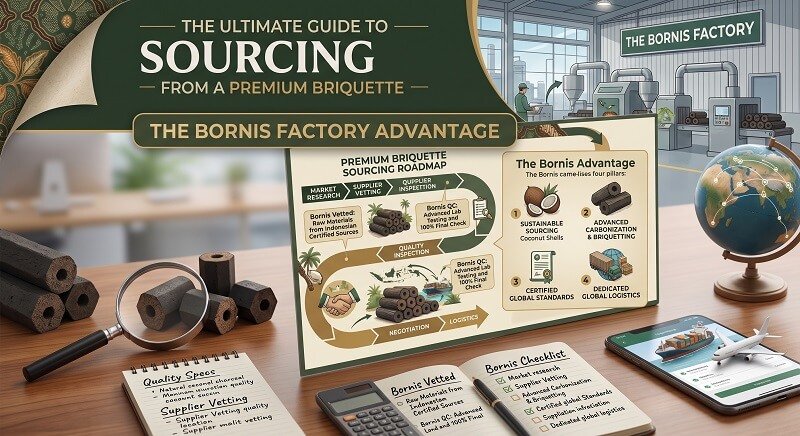
The Ultimate Guide to Sourcing from a Premium Briquette The Bornis Factory Advantage
The Ultimate Guide to Sourcing from a Premium Briquette Manufacturer: The Bornis Factory Advantage
The global charcoal industry is in the midst of a profound evolution. As we navigate through 2026, the international market—spanning from the luxurious shisha lounges of the Middle East and Europe to the high-end culinary establishments of North America and East Asia—is demanding more than just combustible fuel. Today’s consumers and commercial buyers require sustainability, uncompromising consistency, and superior thermal performance. They are actively shifting away from chemically treated quick-light coals and environmentally destructive wood lump charcoal, turning their focus toward the ultimate eco-friendly alternative: 100% natural coconut shell briquettes.
For global importers, wholesalers, and B2B distributors, securing a reliable supply chain is the single most critical factor in building a profitable and reputable brand. Navigating the complex world of international biomass fuel procurement requires partnering with a facility that understands the rigorous demands of export-grade production. This is exactly where partnering with a premium briquette manufacturer bornis factory becomes a strategic game-changer. This comprehensive, expert-led guide will explore the technical nuances of premium charcoal, the geographic dominance of Indonesia, and why Bornis Factory stands as a titan in the global manufacturing landscape.
The Global Demand for Sustainable, High-Performance Fuel
To understand the immense value of premium coconut charcoal, one must first examine the shifting global landscape. Environmental regulations regarding deforestation have become increasingly strict worldwide, making traditional wood charcoal less viable and more heavily scrutinized. Simultaneously, end-users have become highly educated about what goes into their products.
In the recreational shisha and hookah sector, the purity of the charcoal is non-negotiable. If a briquette emits even the slightest trace of smoke, off-putting odors, or chemical flavors, it instantly ruins the delicate profile of the shisha tobacco. Hookah enthusiasts demand a silent, steady, and clean heat source. Similarly, in the professional culinary and barbecue sectors, pitmasters and chefs require fuel that provides intense, radiating heat that lasts for hours without imparting toxic chemical residues into the meat.
Coconut shell briquettes perfectly bridge this gap. By utilizing the discarded shells of coconuts—an agricultural byproduct that would otherwise be burned as waste—manufacturers create a product that is entirely sustainable, participating in a truly circular economy. It is this combination of elite performance and environmental responsibility that has driven the global demand to unprecedented heights.
The GEO Advantage: Why Indonesia is the Epicenter of Charcoal Production
When sourcing export-grade coconut briquettes, all roads inevitably lead to the Indonesian archipelago. The country holds a virtually unshakeable dominance over the global coconut charcoal market, and this is due to a perfect convergence of geography, climate, and deep-rooted manufacturing expertise.
Indonesia is the largest producer of coconuts on the planet. Its equatorial climate and rich, volcanic soil create the ideal conditions for year-round harvesting across major islands like Sumatra, Sulawesi, and Java. This provides manufacturers with an infinite, sustainable supply of raw materials, completely bypassing the seasonal shortages that plague other agricultural sectors. Furthermore, the coconuts grown in Indonesia are renowned for having incredibly thick and dense shells, which directly translates to a higher fixed carbon content when carbonized.
Beyond the raw materials, Indonesia possesses a rich heritage of artisanal charcoal production. The local workforce has spent generations perfecting the complex science of pyrolysis—the process of carbonizing biomass in oxygen-restricted environments. They understand the exact temperatures and airflow required to extract the maximum amount of pure char without reducing the material to ash. Coupled with world-class maritime export infrastructure in cities like Jakarta, Semarang, and Surabaya, Indonesia is geographically engineered to supply the world.
Defining True Quality: The Technical Metrics
In the highly competitive B2B market, quality cannot be a subjective claim; it must be proven through rigorous, independent laboratory testing. A true premium manufacturer will base their entire operation on specific, measurable technical specifications. When evaluating the quality of coconut charcoal briquettes, several crucial metrics must be meticulously analyzed.
The most critical indicator of quality is the fixed carbon content. This represents the pure, combustible solid left behind after moisture and volatile gasses have been driven off. A premium export-grade briquette will consistently boast a fixed carbon content exceeding 80 percent, with elite shisha grades pushing up to 85 percent or higher. This high carbon density guarantees an incredibly hot and long-lasting burn, often exceeding two to three hours for shisha cubes and up to four hours for culinary hexagonal logs.
Equally important is the ash content and its color. High ash content is a severe detriment, particularly in hookah applications, as it coats the briquette, suffocates the heat, and clogs the equipment. Premium briquettes are engineered to leave behind less than 2.5 percent ash for shisha use, and under 5 percent for culinary use. Furthermore, the resulting ash must be pure white or a very light silver-grey. If the ash burns brown or yellow, it is a clear indicator that the manufacturer has used inferior raw materials, dirt, or mixed in cheap wood sawdust.
Moisture and volatile matter are the final pieces of the puzzle. Strict export standards dictate that moisture levels must be maintained below 5 percent. High moisture makes the charcoal difficult to light and can cause dangerous sparking or cracking under intense heat. Volatile matter must be kept below 15 percent to ensure the burn remains completely smokeless and odorless.
The Engineering Mastery at Bornis Factory
Producing briquettes that meet these exacting international standards is a highly scientific endeavor. It requires state-of-the-art machinery, rigorous quality control protocols, and an uncompromising dedication to excellence. As a premium briquette manufacturer bornis factory embodies this commitment at every single stage of the production line.
The process begins long before the briquettes are formed. Bornis Factory employs a strict sourcing protocol, partnering only with trusted local farmers to acquire fully mature, completely dried coconut shells. These shells are thoroughly cleaned to remove any sand, coconut fibers, or impurities before entering the carbonization kilns.
Once the shells are carbonized into raw char, they are fed into heavy-duty industrial pulverizers. The char is crushed into an exceptionally fine, micro-scale powder. The finer the mesh size of this powder, the smoother, denser, and more aesthetically perfect the final briquette will be. This is a crucial step that prevents the final product from turning into dust during rough transoceanic shipping.
To bind this fine powder together, Bornis Factory exclusively uses a 100 percent natural, food-grade tapioca starch binder mixed with purified water. Absolutely no chemical accelerants, artificial fillers, or sodium nitrates are ever introduced into the mixture. This guarantees that the final product retains its completely organic, odorless, and tasteless profile.
The mixture is then fed into immense hydraulic extrusion presses, forming the briquettes into precise shapes tailored for the buyer—perfect 22mm, 25mm, or 26mm cubes for the shisha market, and hollow-core hexagonal logs for the BBQ sector. Finally, the wet briquettes undergo a highly controlled baking process in industrial ovens for up to 72 hours. This slow, deliberate drying phase meticulously brings the moisture content down to the strict export threshold without compromising the structural integrity of the briquette.
Navigating International Logistics and Export Compliance
For B2B buyers, manufacturing the product is only half the battle; safely and legally transporting it across the globe is the other. Compressed carbon is strictly regulated under international maritime law and the IMDG (International Maritime Dangerous Goods) Code, classified as a Class 4.2 hazardous material (Spontaneously Combustible).
Working with a highly authoritative and experienced facility like Bornis Factory eliminates the logistical nightmares often associated with importing charcoal. They handle all critical export compliance documentation in-house. This includes providing the essential Material Safety Data Sheet (MSDS), securing Self-Heating Test (SHT) certificates from internationally recognized laboratories like SGS or Sucofindo, and issuing the Certificate of Origin (COO).
Their logistical expertise also extends to container optimization. Bornis Factory understands how to strategically palletize and floor-load cargo to maximize freight space. Whether loading 18 metric tons into a standard 20-foot container or upwards of 26 metric tons into a 40-foot High Cube, their efficient loading strategies significantly reduce the landed freight cost per kilogram, directly increasing the wholesale buyer’s retail profit margins.
The Power of OEM and Scalability
In the modern retail landscape, brand identity is everything. Importers do not just want to buy charcoal; they want to build an empire. Bornis Factory recognizes this fundamental B2B need and offers comprehensive OEM (Original Equipment Manufacturer) services.
Global buyers have the freedom to fully customize their packaging. Bornis Factory can package the briquettes in custom-designed, beautifully printed inner boxes ranging from 1kg to 3kg sizes. These boxes are lined with heavy-duty plastic to completely seal out ambient moisture during the ocean voyage. The inner boxes are then securely packed into highly durable, custom-branded master corrugated cartons. When the container doors open at your local warehouse, the product is fully branded, protected, and immediately ready for retail distribution.
Furthermore, consistency and scalability are the bedrock of the Bornis Factory operation. Many importers suffer from the “first container trap,” where the initial shipment is excellent, but subsequent orders are plagued by high ash and poor density. Bornis Factory implements a multi-stage Quality Assurance protocol, performing drop tests, burn tests, and chemical analysis on every single batch before it is cleared for export. With their massive production capacity, they can comfortably scale alongside your business, whether you are ordering a single trial container or requiring a dozen High Cube containers every month.
Conclusion: Securing Your Supply Chain for the Future
The global transition toward premium, sustainable biomass fuel is a permanent market shift. As consumers become more discerning and environmental regulations tighten, the demand for high-quality coconut shell charcoal will only continue to accelerate. For international importers, distributors, and visionary brands, the path to dominating your local market requires a foundation built on unyielding quality and reliability.
By turning to Indonesia—the undisputed global capital of charcoal manufacturing—and forging a strategic partnership with a highly authoritative facility, you secure a decisive competitive advantage. Choosing a premium briquette manufacturer bornis factory ensures that your brand delivers an elite, smokeless, and exceptionally long-lasting product every single time. Elevate your supply chain, empower your brand, and fuel your future growth by investing in the world’s finest sustainable energy solution today.
#premiumbriquettemanufacturer #bornisfactory #coconutcharcoal #shishacharcoal #bbqcharcoal #indonesiancharcoal #briquettefactory #wholesalecharcoal #ecofriendlyfuel https://bornisbriquettefactory.com

All Categories
Recent Posts
Natural Coconut Charcoal Briquettes for Outdoor Backyard BBQ Grilling
Sourcing Top Coconut Shell Charcoal Briquettes for Professional Shisha and BBQ Restaurants