Sourcing Excellence: The Ultimate Guide to Partnering with a Bulk Supplier of Natural Coconut Charcoal
Sourcing Excellence: The Ultimate Guide to Partnering with a Bulk Supplier of Natural Coconut Charcoal
The global energy and hospitality sectors are currently undergoing a massive and irreversible paradigm shift. As international environmental regulations become increasingly stringent and end-consumers grow highly conscious of the ecological devastation caused by traditional hardwood charcoal, the demand for sustainable, high-performance biomass alternatives has skyrocketed. At the forefront of this global green revolution is coconut shell charcoal. For international importers, wholesale distributors, and global brand owners looking to dominate their respective markets, navigating this transition requires securing a highly dependable supply chain. In an industry often plagued by intermediaries and inconsistent product quality, forging a direct partnership with a reliable bulk supplier of natural coconut charcoal is not just a sourcing decision; it is a critical strategic imperative for long-term scalability and market dominance.
The Geographic Superiority of Indonesian Biomass (GEO Targeting)
To truly master the international charcoal trade, B2B buyers must first understand the geographical realities that dictate raw material quality. The Republic of Indonesia stands as the undisputed global titan of the coconut charcoal industry, and this dominance is entirely by geographical design. Straddling the equator, the Indonesian archipelago provides the ultimate pristine tropical climate combined with incredibly nutrient-dense, mineral-rich volcanic soil.
These specific environmental factors create the perfect agricultural conditions for cultivating the world’s most robust coconut plantations across key islands such as Sulawesi, Sumatra, and Java. The physical characteristics of the raw agricultural material directly dictate the thermodynamic performance of the final manufactured briquette. Coconuts harvested in these specific Indonesian regions yield shells that are exceptionally thick, hard, and dense. When these specific shells undergo the carbonization process, they produce a raw material with a remarkably high fixed carbon content. For global importers looking to supply highly competitive markets in the Middle East, Europe, or the Americas, this geographical advantage translates directly into product superiority. Briquettes manufactured from Indonesian shells fundamentally possess a higher energy density, meaning they burn significantly hotter, last exponentially longer, and leave behind a mere fraction of the ash compared to charcoal sourced from other tropical regions.
Demonstrating Manufacturing Expertise and Authority (EEAT)
In the highly competitive export sector, Experience, Expertise, Authoritativeness, and Trustworthiness (EEAT) are the foundational pillars of a reliable supply chain. A true direct factory distinguishes itself from mere trading companies through total operational transparency and rigorous, verifiable industrial practices. Transforming raw agricultural waste into a premium, export-grade energy source is a complex engineering endeavor that requires advanced machinery, precise thermal management, and uncompromising quality assurance protocols at every stage of production.
A premier bulk supplier proves their expertise through strict adherence to the following technical benchmarks:
- Optimal Fixed Carbon Levels: The absolute hallmark of a premium briquette is its fixed carbon content. Expert manufacturers consistently achieve fixed carbon levels exceeding 75%, often pushing past 80% for ultra-premium grades. This metric alone dictates the thermal efficiency, heat output, and longevity of the burn.
- Minimal and Clean Ash Residue: High-quality production lines utilize advanced crushing and sifting technology to remove all impurities, sand, and unburned fibers before the briquettes are even formed. This ensures the final product leaves minimal ash—typically below 2.5% for premium shisha applications and under 5% for culinary use. The resulting ash must be pristine white or light grey, indicating a pure, unadulterated burn.
- Eradication of Volatile Matter: Thorough, highly controlled carbonization ensures that all volatile gases are entirely burned off during the initial processing phase. This critical step guarantees a final briquette that is 100% smokeless, odorless, and spark-free upon ignition, ensuring user safety and a premium experience.
- Precision Moisture Control: Freshly extruded briquettes contain residual moisture from the natural binding process. Authoritative factories utilize massive industrial dehumidification ovens, slowly baking the briquettes for 24 to 48 hours to reduce internal moisture content strictly below 5%. This precise drying process prevents the charcoal from cracking, splitting, or exploding under intense heat.
- 100% Natural Binding Agents: Elite manufacturers exclusively use 100% natural, food-grade binders, such as pure tapioca starch blended with water. They absolutely forbid the use of synthetic adhesives, chemical lighting accelerators, nitrates, or sawdust fillers, ensuring the briquettes are entirely non-toxic.
Segmenting Production for Diverse Global Markets
A hallmark of a trusted bulk supplier of natural coconut charcoal is its ability to adapt and segment production lines to meet the wildly different demands of global consumer markets. A generic, one-size-fits-all approach is a recipe for failure in the specialized charcoal export business.
The Exacting Standards of the Shisha and Hookah Industry
Supplying the global hookah market requires obsessive attention to detail. Shisha lounges demand charcoal that is completely inert in both taste and smell; any chemical odor or residual smoke will instantly ruin the delicate flavor profile of the molasses tobacco. Geometrical precision is equally critical. Briquettes must be pressed into flawless cubes, typically measuring 22mm, 25mm, or 26mm, or formed into specific flat shapes. This precise geometry allows users to accurately manage heat distribution over a hookah bowl. Furthermore, structural integrity must be absolute. The charcoal cannot crack when lit, and the ash must adhere to the cube rather than flaking off and falling into the tobacco, which would create a harsh smoking experience.
The Heavy-Duty Demands of Commercial Barbecue Sectors
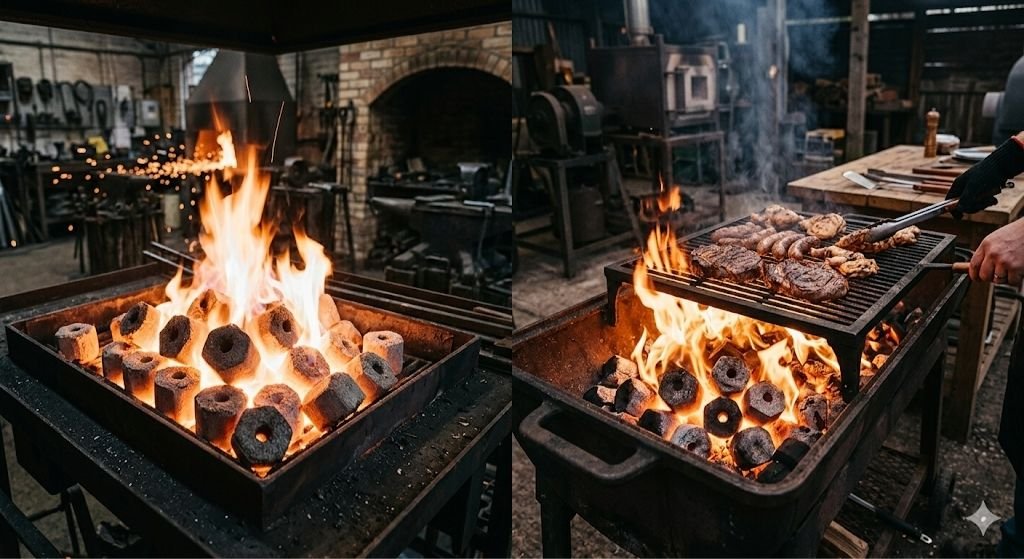
Conversely, the commercial barbecue sector requires a fundamentally different product architecture. Restaurants, steakhouses, and outdoor grilling enthusiasts need charcoal that can generate rapid, aggressive heat to sear thick cuts of meat, while sustaining that high temperature over long commercial service hours. For this market, briquettes are typically extruded into larger hexagonal or cylindrical shapes, frequently featuring a hollow center hole. This specific aerodynamic design maximizes oxygen flow through the center of the coal, drastically increasing heat output. While burn duration is vital for kitchen efficiency, the highest priority remains a completely clean, chemical-free smoke profile to guarantee food safety and preserve the authentic, natural flavor of the cuisine.
The Strategic Economics of Bulk Procurement
Engaging directly with a factory for bulk purchasing offers immense economic and strategic advantages for global importers. Purchasing in Full Container Loads (FCL), whether utilizing standard 20-foot containers or 40-foot High Cube containers, drastically reduces the per-kilogram cost of the product. This economy of scale empowers distributors to maintain highly competitive retail pricing in their local domestic markets while preserving excellent, sustainable profit margins.
Furthermore, a premier bulk supplier acts as a silent, high-capacity partner by offering comprehensive Original Equipment Manufacturer (OEM) and private label services. This B2B model empowers international buyers to fully customize their orders without the massive capital expenditure required to build and staff their own manufacturing facility. Buyers can dictate the exact specifications of the briquette, from the dimensions to the specific blend ratios. The supplier handles end-to-end custom packaging solutions, coordinating the printing of highly detailed, brand-specific inner retail boxes, heavy-duty master cartons tailored for warehouse stacking, and custom plastic inner liners designed to protect the product from ambient ocean humidity. By leveraging these comprehensive white-label services, businesses can deploy market-ready products directly to retail shelves, building invaluable brand equity.
Navigating the Complexities of International Export Logistics
The true test of a manufacturer’s reliability and authority is their logistical execution. Shipping bulk charcoal across international waters is a highly regulated and potentially complex undertaking. Under international maritime regulations (specifically the IMDG Code), charcoal is frequently classified as a potentially combustible material, requiring meticulous handling, specific container preparation, and rigorous documentation.
An experienced direct factory manages this complexity seamlessly on behalf of the importer. They handle the preparation of all mandatory export documentation, including comprehensive Material Safety Data Sheets (MSDS), Certificates of Analysis (COA) conducted by independent, internationally recognized testing laboratories, and the crucial Self-Heating Test Certificates (SHTC) required by global shipping lines to prove the cargo is safe for transoceanic transit.
Physical container preparation is treated as an exact science. Reputable factories ensure that containers are properly lined with Kraft paper and heavily loaded with industrial-grade desiccants (moisture absorbers). This prevents condensation and humidity damage during the weeks-long ocean transit, a phenomenon known as “container sweat.” The briquettes themselves undergo intense physical stress testing—including multiple drop tests from varying heights—prior to packaging, guaranteeing they possess the structural density to survive the vibrations and impacts of shipping without degrading into pulverized dust upon arrival.
The Imperative of Environmental Sustainability
In today’s global economy, ethical sourcing and environmental responsibility are no longer optional marketing angles; they are strict requirements demanded by regulatory bodies and consumers alike. The coconut charcoal industry offers a profound, scalable solution to the ecological devastation caused by traditional charcoal production.
By utilizing coconut shells—a natural, rapidly renewable byproduct of the copra, coconut milk, and coconut oil industries—manufacturers are effectively upcycling millions of tons of agricultural waste that would otherwise be left to rot or be openly burned. This sustainable model entirely eliminates the need to harvest timber, standing in stark contrast to the devastating deforestation driven by the traditional lump wood charcoal industry. Partnering with a dedicated, eco-conscious facility ensures that your supply chain is not only highly profitable but actively contributes to global conservation efforts.
Securing Your Market Position for the Future
The global transition toward high-efficiency, sustainable biomass energy is accelerating rapidly. Those who secure reliable, high-capacity supply chains today will be the ones who dictate market pricing and quality standards tomorrow. To thrive in this fiercely competitive international arena, businesses must bypass intermediaries and forge direct relationships with highly capable factories situated exactly where the raw materials grow. By demanding uncompromising technical precision, strictly verified quality control, and seamless logistical execution, global importers can aggressively mitigate risks while maximizing their return on investment.
To explore comprehensive B2B production capabilities, review highly detailed product specifications, and establish a rock-solid, long-term manufacturing partnership tailored strictly to your operational needs, connect with the industry experts at Bornis Briquette Factory today.
#BulkSupplierOfNaturalCoconutCharcoal #CoconutCharcoal #BriquetteFactory #ShishaCharcoal #BBQCharcoal #OEMCharcoal #BornisBriquetteFactory https://bornisbriquettefactory.com/

All Categories
Recent Posts
Sourcing Excellence: The Ultimate Guide to Partnering with a Bulk Supplier of Natural Coconut Charcoal
Sourcing Premium Biomass: The Strategic Edge of a Direct Coconut Briquette Factory in Indonesia